

Quick Summary
To finish dissertation while working full-time, set a realistic completion date, then count backward to see whether your weekly hours can support it. Protect fixed writing blocks on your calendar, break the work into chapter milestones with buffer time, and add an accountability partner or coach to keep momentum.
- Count backward from a target defense month and add at least one month of buffer for feedback rounds.
- Schedule recurring writing blocks like client meetings, and leave one open block each week for catch-up.
- Plan four stages per chapter: research complete, first draft, revision after feedback, and final polish.
- Confirm supervisor, ethics, and committee waiting periods with your program before locking the timeline.
- Use a weekly review to pick one critical task and the smallest useful win for the coming seven days.
Table of Contents
- Why Working and Writing Stall Out (and What Changes It)
- Step 1: Set a Realistic Completion Timeline
- Step 2: Build a Dissertation Writing Schedule for Working Professionals
- Step 3: Break the Dissertation Into Chapter Milestones
- Step 4: Protect Your Writing Time Week by Week
- Step 5: Use Accountability to Keep Momentum
- Recovering From Stalls, Burnout, and Long Breaks
- Booking Your Next Step With Dissertation Prep
- Frequently Asked Questions
How to Finish Your Dissertation While Working Full-Time
Last Updated: November 21, 2026
Why Working and Writing Stall Out (and What Changes It)
Most people who stall while trying to finish dissertation while working are not lazy. They are tired, and their dissertation has no deadline anyone else can see.
Doctoral attrition is a serious problem. Dissertation Prep's mission is built around the 40% to 50% attrition rate that doctoral candidates face in the ABD (All But Dissertation) stage.
Stalling usually comes from three things:
- No fixed writing time. Writing gets squeezed into whatever hours are left.
- Vague goals. "Work on chapter 3" is too big to start on a tired Tuesday.
- No one checking progress. Without a chair or coach asking for updates, weeks slip by unnoticed.
The good news is that each of these has a simple fix. The steps below walk through them in order.
Step 1: Set a Realistic Completion Timeline
Start by deciding when you want to finish your dissertation while working full-time. Then count backward to see whether that date fits your life.
Your program, your methodology and your committee all change how long the work takes.
Try this:
- Pick a target defense month.
- List each remaining chapter and give it a rough start and finish month.
- Add buffer time of at least one month for feedback rounds from your chair.
If the math does not work, change the date now. A realistic timeline you keep is worth more than an ambitious one you abandon in month four.
Step 2: Build a Dissertation Writing Schedule for Working Professionals
A working professional needs a schedule that survives a bad week. Fixed blocks beat open-ended intentions, but the blocks that work depend heavily on the shape of your job. A plan built for a 9-to-5 office worker falls apart for a nurse on rotating shifts or a parent managing school pickups. Below are three starting templates you can adapt, followed by the rules that apply to all of them.

If you work a standard office schedule
Your predictable hours are early morning, lunch, and the stretch after dinner. Most people in this group do best with two short weekday sessions and one longer weekend block.
- Tuesday and Thursday, 6:30 to 7:30 a.m.: draft or revise one subsection before the workday starts.
- Wednesday lunch, 30 minutes: read sources or outline the next section. Keep this light so it does not compete with actual writing.
- Saturday, 9 a.m. to noon: the deep work block for analysis, tables, or a full section draft.
That is roughly four and a half hours a week. It sounds small, but kept for a semester it moves a chapter forward. The morning slot matters because it happens before work email can hijack the day.
If you work rotating or shift hours
Shift workers cannot rely on the same clock time each week, so anchor your writing to the shift pattern instead of the day. Build your schedule around the two or three days per rotation when you are off or on a late start.
- Map your rotation two weeks ahead and mark the days with the most usable energy.
- Put writing blocks on the days after a rest day, not the day after a night shift.
- Use 45-minute sessions rather than 90-minute ones, because shift fatigue shortens focus.
A common pattern is three 45-minute sessions across a two-week rotation. It is less than an office worker's total, so shift workers often need a longer overall timeline. That is a planning fact, not a failure.
If you are a caregiver or have unpredictable home demands
Caregivers rarely get uninterrupted evenings. The workable approach is to claim smaller units and defend them hard.
- Identify the 30 to 45 minutes when another adult or a sitter is reliably present, and protect that slot first.
- Trade one weekend morning with a partner or family member so you get a longer block every other week.
- Keep a running list of five-minute tasks (fix a citation, add a topic sentence, reply to a supervisor email) for the fragmented moments.
Rules that apply to every schedule
- Make each block a recurring calendar event with a reminder. Treat it like a client meeting.
- Do not plan every free hour. Leave one open block each week for catch-up, because a schedule with zero slack breaks the first time work runs late.
- Short, regular sessions usually beat one long session you can never find time for. Two 90-minute sessions kept every week add up faster than a single six-hour Saturday you keep skipping.
Watch out: Building a schedule around the hours you wish you had, rather than the hours your job and home life actually leave open, is the most common reason these plans collapse in week three.
Step 3: Break the Dissertation Into Chapter Milestones
"Finish the dissertation" is too big to act on. Chapter milestones give you smaller targets with clear finish lines, and they also let you see whether your defense date is realistic before you are three months into a plan that cannot work.
Turn the defense date into four milestone types per chapter
For each remaining chapter, plan four stages rather than one:
- Research complete. Sources gathered, data collected or analyzed, notes organized.
- First full draft. Every section written, even roughly.
- Revision after supervisor feedback. Comments addressed and a clean version returned.
- Final polish and formatting. Citations checked, tables formatted, chapter approved.
Most stalled candidates plan only stage two. The other three stages are where weeks disappear, so they belong on the calendar from the start.
A worked example
Suppose you are aiming to defend in ten months and have three chapters left (results, discussion, conclusion). A plan might look like this:
- Months 1 and 2: finish analysis and write the results chapter first draft.
- Month 3: send results to your supervisor and start the discussion chapter while you wait.
- Month 4: revise results, draft discussion.
That buffer is not padding. Supervisor feedback can take several weeks, and committee members are often slower during teaching terms. A plan with no buffer treats a normal delay as a crisis.
Translate each milestone into weekly goals
A milestone like "draft the discussion chapter by month five" becomes weekly goals such as "draft 800 words of the discussion this week" or "write the limitations subsection and send it to my peer reader." Specific weekly goals are checkable, and they make it easy to explain progress to your chair, who can then give more targeted feedback.
Build in dependencies and feedback loops
Some milestones depend on other people. Before you lock the plan, confirm three things with your program:
- How far in advance your supervisor needs a full draft before a defense can be scheduled.
- Whether your institution requires formatting checks, ethics approvals, or a pre-defense review that add fixed waiting periods.
- How long your committee typically takes to return comments.
Add those waiting periods to the calendar as real blocks. A chapter you cannot revise until feedback arrives is not a writing week, so plan a parallel task such as drafting the next chapter or cleaning references.
Watch out: Planning every chapter to finish exactly on its deadline with no slack between stages means one late feedback round pushes the entire defense date, so keep at least one month of buffer before submission.
Step 4: Protect Your Writing Time Week by Week
Once a week, review the coming seven days. Ask three questions:
- Which blocks are already booked?
- Which critical task must move forward this week?
- What is the smallest useful amount of progress I can count as a win?
Keep the critical task at the top of the list. Everything else is secondary. If a block gets cancelled, move the critical task to the next open slot instead of letting the whole week slide.
A simple weekly list might look like this:
- Monday: 60 minutes, reread the last chapter and note gaps
- Wednesday: 90 minutes, draft two subsections
- Saturday: 2 hours, complete the revised table and a short summary
Protecting time also means protecting it from your own excuses. Set a reminder, tell a family member your writing hours, and treat them as real appointments.
Step 5: Use Accountability to Keep Momentum
Working alone for months is hard. Accountability gives you someone to report to, which often matters more than any planning method.
Options include:
- A weekly check-in with a peer in your program
- A dissertation accountability or content coach who reviews your goals
- A shared progress tracker that your chair can see
Accountability works best when it is specific. Tell your partner or coach the goal for the week and the date you will report back.
If you want structured support, Dissertation Prep offers Accountability and Content Coaching, where a coach helps you set milestones and keep momentum through regular check-ins.
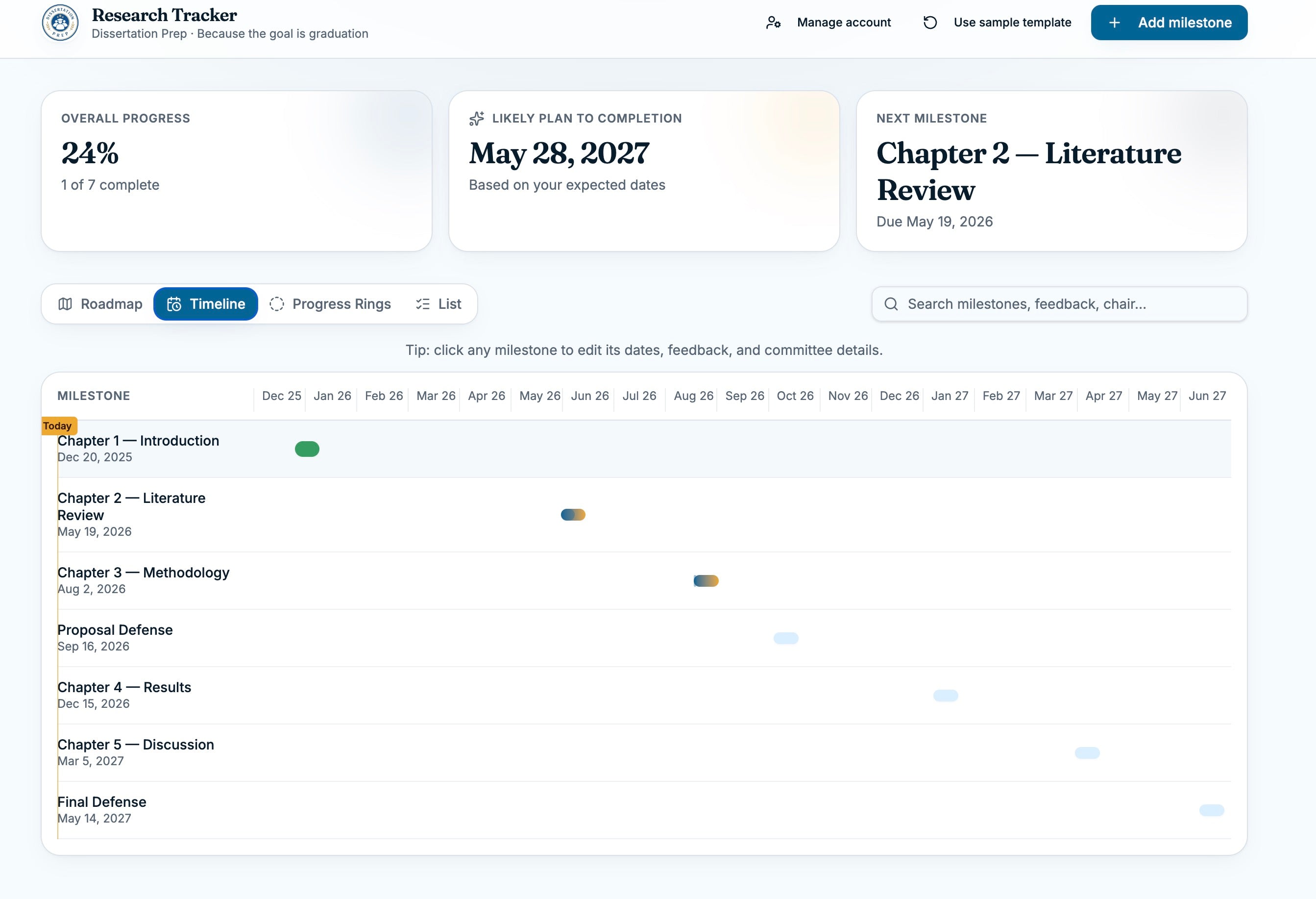
For students who want a tool to see progress at a glance, the Student Dissertation Tracker Dashboard turns the plan into a visual week-by-week roadmap you can share at committee meetings.
Recovering From Stalls, Burnout, and Long Breaks
Almost everyone stalls at some point. A job change, a family emergency or plain exhaustion can pause progress for weeks or months. The goal is a fast, low-drama return.
When you come back:
- Start small. Schedule one short session in the first week, not a marathon.
- Reread your last chapter summary. This rebuilds context faster than starting from scratch.
- Send your chair a short update. Say where you are and what your next milestone is.
Burnout needs its own response. If you feel dread every time you open the document, reduce the workload first. Shorten the weekly goal, take a planned rest day, or ask a coach to help you break a task that feels stuck.
Booking Your Next Step With Dissertation Prep
If you are reading this while balancing a job and a dissertation, you do not need to solve everything at once. Choose the next step that matches where you are right now:
- If you need a full plan through the final stage, The Dissertation Finish Line Program offers a 12-week, one-on-one coaching partnership for analysis, final chapters and defense preparation.
- If you want a low-commitment start, the 30 Minute Dissertation Coaching Phone Session gives you one focused conversation with an experienced mentor.
Either way, the first step is the same one you learned above: pick a date, protect a block, and name the next milestone. Dissertation Prep can help you keep that plan moving from candidate to graduate.

Frequently Asked Questions
Is it possible to complete a PhD while still working?
Yes, many doctoral candidates finish while holding full-time jobs. The difference usually comes down to structure rather than raw hours. Candidates who fix a weekly writing block, set chapter-level milestones, and check progress with a chair or coach tend to move steadily. Those who wait for large open stretches of time often stall. Plan for a timeline that is longer than a full-time student's, and expect steady, modest weekly progress to add up over the year.
Can I do a PhD part-time while working?
Most programs allow part-time enrollment, and working professionals commonly use that route. Part-time study changes the pace, not the requirements. Confirm with your program what counts as continuous enrollment, how long you have to finish, and whether your chair expects regular meetings. Then build your writing plan around the hours you can protect each week, so the schedule matches your actual job and not an idealized one.
How long does it take to finish a dissertation while working?
The timeline varies with your field, data collection needs, and how many hours you can protect each week. Some working candidates take longer when data collection or revisions run slow. Work backward from a target defense date and check the plan monthly. If the schedule does not fit the weekly hours you actually have, adjust the target early rather than late.
How do I stay motivated to finish my dissertation while working?
Motivation tends to fade when progress is invisible, so make progress visible. Set small weekly goals tied to a specific chapter section, log completed sessions, and review them with someone who expects an update. Short, regular writing sessions build a habit more reliably than occasional long ones. If motivation drops for weeks, treat it as a signal to reduce the scope of your next goal, not as a reason to quit.

-
Message For Students
-
Dani Babb PhD
- Founder of Dissertation Prep
& 20+ Year Doctoral Mentor