

Last Updated: October 30, 2026
Quick Summary
Restarting a dissertation after time away works best as a structured re-entry, not a rewrite. Spend the first two weeks auditing chapters, checking new literature, and rebuilding a short daily writing habit, then reconnect with your advisor using a one-page update. Outside dissertation help adds structure and accountability when progress stalls, but it should never replace your own thinking.
- Treat the first two weeks back as an audit, not a writing sprint.
- Write 30 to 45 minutes most days for two or three weeks to rebuild stamina.
- Send your advisor a short re-entry message with a one-page status update.
- A research update should cover status, changes, next steps, and specific questions.
- Use each support role, such as librarian or coach, only for its designed purpose.
Table of Contents
- Why Returning to Your Dissertation Feels Harder Than It Should
- How to Restart a Dissertation: A Step-by-Step Re-Entry Plan
- Reconnecting With Your Dissertation Advisor After a Long Break
- Preparing a Dissertation Research Update After Time Away
- Building a Dissertation Writing Schedule for Working Adults
- When to Bring in Outside Dissertation Help
- Book Your Complimentary Call and Map Your Comeback
- Frequently Asked Questions
Why Returning to Your Dissertation Feels Harder Than It Should
Coming back to a dissertation after months away is not a failure of discipline. It is a collision between a stalled project and a life that kept moving.
A return is not a fresh start. You are re-entering a project with history, half-built chapters, and a committee that remembers your last draft.
Three things make re-entry harder than the first attempt:
- Lost context. You forget why you made certain choices in your methodology.
- Changed field. New studies appeared while you were away.
- Guilt and burnout. You feel behind, so you avoid the work, which puts you further behind.
That loop is the real enemy. If you stalled after ABD, our guide to finishing your dissertation after ABD covers the specific pressures of coming back after time away.
How to Restart a Dissertation: A Step-by-Step Re-Entry Plan
Restarting a dissertation is a structured re-entry, not a rewrite. Treat the first two weeks as an audit, not a writing sprint. Know where you stand before you produce a single new page.
Below is the sequence we walk candidates through. Follow it in order, and resist the urge to skip ahead to the writing.
| Step | What you do | Time to allow | What success looks like |
|---|---|---|---|
| 1. Take stock | Audit chapters, data, feedback | 1 week | A written status of every chapter |
| 2. Check the field | Scan new literature and methods | 1 week | A short list of updates that affect your work |
| 3. Rebuild the writing habit | Short, timed writing sessions | 2-3 weeks | 30-45 minutes of writing most days |
| 4. Reconnect with your advisor | Send a clear re-entry message | 1 week | A scheduled check-in on the calendar |
| 5. Draft the research update | Summarize progress and next steps | 1 week | A one-page update your chair can respond to |
Step 1: Take Stock of Where You Left Off
Before you write anything, build a clear picture of the project. Open every file, read your last committee feedback, and note what is done, drafted, and missing.
Ask yourself:
- Which chapters are complete, and which are drafts?
- Did you collect all your data, or is collection still open?
- What did your committee ask for in the last review?
Write the answers down. Our student dissertation tracker dashboard gives you a visual roadmap and milestone tracking to see exactly where you stopped and what comes next. That written status becomes your roadmap.
Step 2: Check What Has Changed in Your Field
A field does not stand still while you are away. New studies, updated methods, and fresh debates may affect your research question or literature review.
Set aside a week to scan recent publications in your area. Focus on:
- New studies that speak to your research question
- Updates to your methodology or analysis approach
- Recent guidance on ethics and data handling
You are not rewriting your literature review. You are checking whether your project still fits the current conversation. Note the additions you need and flag anything that has shifted for your advisor.
Step 3: Rebuild Your Writing Muscle Slowly
Writing stamina fades like fitness. You cannot return from months off and expect a full chapter in a weekend.
Start small. Set a timer for 30 minutes and write, even badly. Do that most days for two or three weeks. The point is to rebuild the habit, not to produce polished prose.
A few rules that help:
- Write first, edit later. Never do both at once.
- Start with the section you understand best, not the hardest one.
- Keep a running list of what you will fix on the next pass.
The candidates who finish write consistently, not in heroic bursts followed by a month of silence.
Reconnecting With Your Dissertation Advisor After a Long Break
The first message back to your advisor should be short, honest, and concrete. Do not apologize for pages or explain your whole absence. State where you are, what you have done since returning, and what you need next.
Here is a template you can adapt:
Dear Dr. [Name],
I am writing to restart work on my dissertation after time away. Since returning, I have reviewed my chapters and the last round of committee feedback. My current status is [brief status].
I would like to schedule a short check-in to confirm priorities and agree on next milestones. I can send a one-page update before we meet. Would [date/time] work for you?
Thank you, [Your name]
A common mistake is waiting until you have something impressive to show. Reach out early with a clear plan.
What to bring to the first meeting back
Treat the first meeting as a working session, not a confession. Bring three things:
Accountability and Content Coaching →
- A one-page status update. What is complete, drafted, and outstanding, plus any changes in your field since your last review.
- Two or three specific questions. For example: "Does my current Chapter 3 draft still meet the methodology requirement, or should I revise the sampling section before I collect more data?" Specific questions get specific answers.
- A proposed milestone calendar. Show the next two or three deadlines you think are realistic. Ask your chair to confirm or adjust them. This shifts the conversation from "where have you been" to "what happens next."
When your chair is unresponsive
If your chair is responsive but stretched thin, that is normal. A chair manages many students at once. The candidates who move fastest arrive with a plan and specific questions, not open-ended requests for direction.
But if weeks pass with no reply, you need a polite escalation path. Most programs have a director of graduate studies or a department chair who can help.
Rebuilding the relationship, not just the schedule
A long absence can make advisors wary. They may wonder whether you will disappear again. Rebuild trust by showing up consistently with small, finished pieces of work. Send a short progress note every two weeks, even if the update is "I finished the literature scan and drafted two pages." Consistency signals that you are back for good.
Preparing a Dissertation Research Update After Time Away
A research update after time away is a one-page summary that tells your committee exactly where the project stands.
Include four things:
- Current status. What is complete, drafted, and outstanding.
- Changes since the last review. Any new literature, data, or method updates.
- Proposed next steps. The next two or three milestones with dates.
- Questions for the committee. Two or three specific questions, not a general request for feedback.
Keep it to one page and send it before your meeting so your chair can read it in advance.
This is also where your research skills do the quiet work. Show that you have reviewed your methodology and data plan. If data collection is still open, say so and give a realistic timeline.
Building a Dissertation Writing Schedule for Working Adults
A dissertation writing schedule for working adults has to fit around a job, caregiving, and real life.
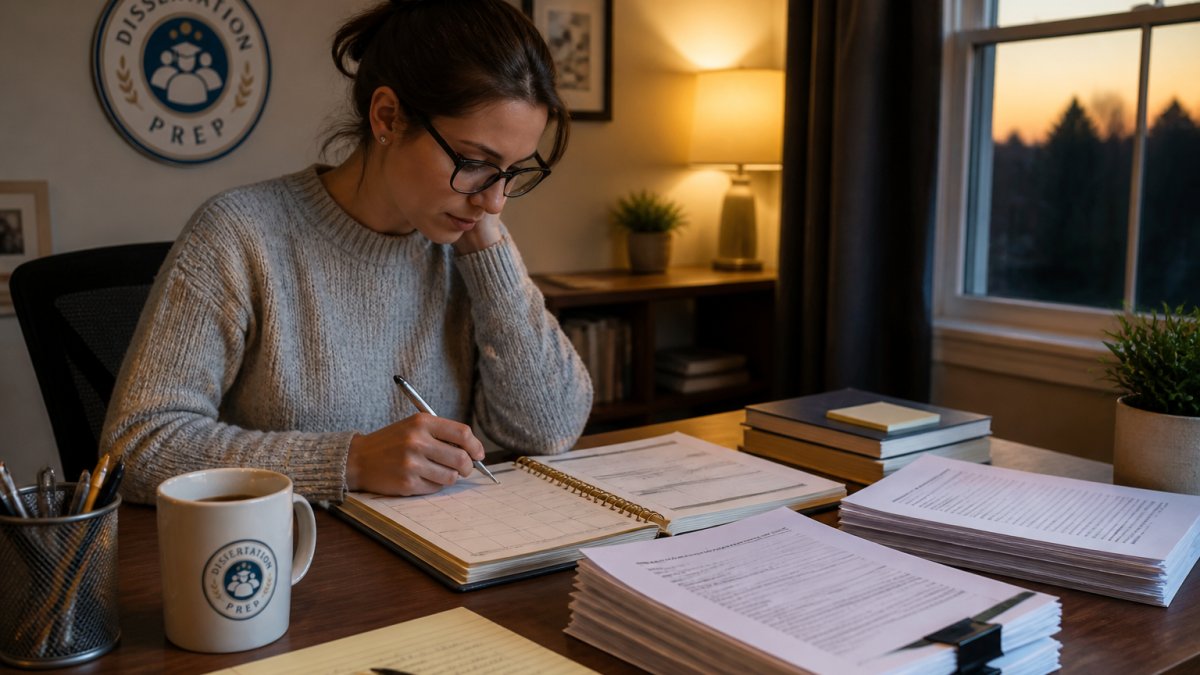
Start with the time you truly have. Be honest about it:
- Weekday blocks. Two or three 45-minute sessions, early morning or after children are asleep.
- One longer weekend block. Two to three hours for the work that needs deep focus.
- A weekly review. Fifteen minutes to plan the next week and check progress.
Protect those blocks like meetings. Turn off notifications. Tell the people around you that this time is booked.
Working adults often need outside accountability to keep a rebuilt schedule on track. Our accountability and content coaching pairs you with a dedicated coach who helps set milestones, review progress, and keep you accountable. Our accountability and content coaching pairs you with a dedicated coach who helps set milestones, review progress, and keep you accountable.

When to Bring in Outside Dissertation Help
Outside dissertation help is worth considering when progress has stalled for reasons your program cannot fix. Our doctoral degree completion coaching services guide gives a clear overview of what coaching involves before you commit. A coach does not write your dissertation. A good coach gives you structure, feedback, and accountability so you can finish your own work.
Consider outside support when:
- You have restarted more than once and stalled again.
- Your chair is unresponsive or hard to reach.
- You are stuck on methodology, statistics, or analysis.
The support roles you can use, and what each one is for
Most candidates think of "dissertation help" as a single service. In practice, there are several distinct roles, and each has a different boundary. Knowing which role fits your blocker saves time and keeps you on the right side of academic integrity.
| Support role | Best for | What they should not do |
|---|---|---|
| Research librarian | Finding literature, database searches, citation management | Write your literature review |
| Methods consultant | Study design, statistics, analysis software | Run your analysis and interpret results for you |
| Writing group or peer reviewer | Accountability, feedback on clarity and structure | Rewrite your chapters |
| Dissertation coach | Planning, milestones, accountability, revision feedback | Write or substantially rewrite your dissertation |
| Editor or proofreader | Grammar, formatting, reference consistency | Change your arguments or add content |
Candidates often try to solve every problem with one person. That rarely works. A librarian can rebuild your literature search in an hour. A methods consultant can review your analysis plan before you collect more data.
Where the academic integrity line sits
Here is the line that matters: support should make your thinking sharper, not replace it. At DissertationPrep, our coaches work with you on structure, methodology, and revisions. They do not write the dissertation for you.
Most universities publish clear guidance on acceptable editing versus ghostwriting. Before you hire anyone, check your program's policy on outside assistance. A good rule of thumb: if the help changes the ideas, it is too far.
Coordinating support so it does not create new problems
More support is not always better. Too many helpers can create conflicting feedback and extra work. Pick one primary support for your current blocker, use it for a defined period, then reassess.
For a specific blocker, a focused session can be enough. Our 30 Minute Dissertation Coaching Phone Session gives quick, focused help on one specific challenge, such as statistics or methodology.

Book Your Complimentary Call and Map Your Comeback
Restarting a dissertation after time away is hard, but it is a problem with a plan. The candidates who finish are not the ones who never stalled.
If you are ready to stop circling the same chapter, we can help. DissertationPrep pairs you with doctorally qualified research coaches.
Book your complimentary call and map your comeback with a coach who has walked this road with candidates just like you.
Frequently Asked Questions
Can I return to a doctoral program after stopping before completing my dissertation?
Yes. Many universities allow ABD students to return after a leave of absence, though you may need to reapply, pay a continuation fee, or meet a new residency requirement. Your first step is to contact the graduate school and your dissertation chair to confirm your status. Ask about deadlines for re-enrollment and whether your committee remains intact. Once you know the rules, you can plan a realistic timeline for finishing.
How do I find out whether my dissertation research is still current?
Run a fresh literature search using the same databases you used before, focusing on papers published since your last review. Check whether key theories, methods, or datasets have been updated. If your topic has shifted, note the changes in a short memo for your committee.
What dissertation help is available for working adults who feel stuck?
Options range from your university's writing center to private coaching and editing services. Dissertation Prep offers accountability and content coaching, proposal and finish line programs, and professional dissertation editing. These services are designed to support your own work rather than write it for you.
How can I rebuild a consistent dissertation writing routine after months away?
Start with short, fixed blocks of time, such as 25 minutes three times a week, and protect them on your calendar. Set a single goal for each session, like revising one paragraph or reading two articles. Track your progress in a simple log. A writing group or an accountability coach can add external structure. The key is consistency over intensity, especially in the first month back.

-
Message For Students
-
Dani Babb PhD
- Founder of Dissertation Prep
& 20+ Year Doctoral Mentor